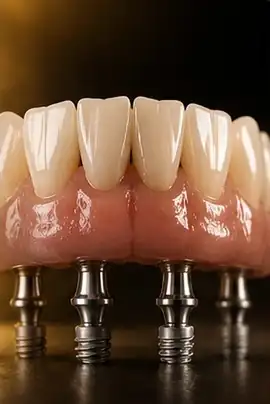
All-on-4 can be an excellent full-arch solution, but four implants are not a universal formula. The final tooth position, bone anatomy, implant distribution, bite and long-term maintenance should drive the plan.
Have X-rays, a scan or an existing treatment plan? Send it with your message.
GoalA fixed full-arch restoration
Implant countFour is common, not automatic
Immediate teethPossible in selected cases
UPPER, LOWER OR BOTH ARCHES?
Know the complete treatment path before you travel.
Full-arch treatment is more than implant placement. We plan the surgery, provisional phase, healing, final restoration and return visits as one coordinated case.
+ Upper + lower cases planned together+ Three-visit pathway for selected cases+ Hotel stay can be coordinated
UPPER + LOWER$25,000 USDFor qualifying cases after clinical evaluation.
A COMPLETE TWO-ARCH PATHWAY
One plan from surgery to final teeth.
For patients who need both arches rehabilitated, NONE32 can coordinate the upper and lower treatment as one planned pathway instead of a collection of disconnected appointments.
01 Surgery + provisional phase02 Healing + final records03 Final restoration delivery+ Hotel stay coordinated for the planned visits
Implant number, immediate loading, grafting, restorative design and exact visit sequence depend on examination, imaging, stability and individual clinical needs. Your written treatment plan defines what is included in your case.
Clear information. Real limitations. Individual planning.
NO TWO PATIENTS ARE THE SAME.
01
THE CONCEPT
Replace an arch, not just individual teeth.
A fixed complete-arch prosthesis replaces the teeth of an entire upper or lower arch and is supported by strategically distributed implants. The All-on-4 concept commonly uses four implants, often with the posterior implants angled to improve distribution and work around anatomy.
The number of implants should follow the prosthetic design, arch form, available bone, opposing bite, cantilever length and restorative material. In some patients, six implants or a different design may provide a better solution.
02
IMMEDIATE FIXED TEETH
Often possible. Never something we should promise before stability is confirmed.
Immediate fixed provisional teeth are supported by clinical evidence in carefully selected edentulous patients. The key word is selected. Primary stability must be confirmed and the prosthesis must be designed to control functional load while the implants heal.
If one or more implants do not achieve the required stability, if significant grafting is needed, or if other risk factors are present, the safer pathway may involve a staged or delayed loading protocol.
03
WHAT YOUR 3D PLAN SHOULD ANSWER
Where the teeth need to be comes before where the implants can go.
Full-arch treatment should be planned backward from the final restoration. That means evaluating smile line, lip support, available restorative space, bone volume, implant distribution, anatomy, bite and hygiene access before surgery.
A scan can show anatomy and available bone, but the final decision also depends on clinical examination, tissue condition, tooth prognosis if teeth remain, and what happens during surgery.
Are remaining teeth truly hopeless, or can some be predictably preserved?
Is a fixed bridge the right prosthesis for the patient’s anatomy and hygiene ability?
Are four implants enough for this arch and restorative design?
Can a provisional bridge be loaded immediately?
Will grafting, sinus treatment or additional implants improve the plan?
04
THE PROVISIONAL IS NOT THE FINAL
Day-one teeth and final teeth have different jobs.
When immediate loading is appropriate, the first fixed bridge is usually a provisional restoration. Its job is to provide appearance and controlled function during healing while protecting the implants from excessive forces.
After healing and tissue maturation, the final prosthesis can be designed around the established bite, phonetics, smile, cleansability and material choice. Patients should understand from the beginning what is provisional, what is final and what may change between the two.
05
EXPECTATIONS AFTER SURGERY
Fixed does not mean “eat anything tomorrow.”
Swelling, bruising, tenderness and a temporary change in speech are common early experiences after extensive surgery. A modified diet and careful hygiene are important while tissues heal and while an immediately loaded provisional is protected.
The bridge must also be cleaned underneath. A fixed full arch still requires daily hygiene and professional maintenance.
06
LONG-TERM REALITY
The implants and the prosthesis have different maintenance needs.
Implants can remain stable while a prosthetic component needs repair, adjustment or replacement. Full-arch restorations can experience wear, screw-related issues, chipping or other technical complications; the tissues around implants can also develop biological complications.
That is why the best full-arch plan includes a maintenance strategy, not just a surgery date.
07
CROSS-BORDER CARE
Know the complete number of visits before you commit.
For patients traveling from California or elsewhere in the U.S., we plan the sequence around diagnostics, surgery, provisional treatment, healing checks, final records and delivery. Complex full-arch treatment should not be sold as a one-trip procedure unless the actual clinical sequence supports that claim.
You should leave the consultation knowing what happens if immediate loading is not possible and how follow-up will be handled.
THE NONE32 STANDARD
We get why you are asking.
Patients should not have to search a Facebook group to discover the question they wish they had asked before treatment. Our goal is to explain the plan, alternatives, limitations and expected sequence before you commit.
That does not mean every outcome can be guaranteed. It means uncertainty should be discussed honestly and the treatment should be built around the person in front of us.
WE GET IT. WE GOT YOU.
REAL PATIENT EXPERIENCES
Don't take the website's word for it.
Read what patients say about their experience with NONE32 on Google. We keep the reviews there so you can see them in their original context rather than selected or rewritten here.
These pages are written for patient education and are not a diagnosis. Clinical decisions are made after an examination and appropriate records. We reference independent professional and scientific sources so you can continue reading.
Send us your question, recent X-rays or treatment plan if you have them. We will tell you what information is still needed before a meaningful recommendation can be made.