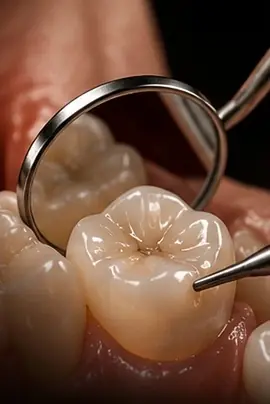
General dentistry is the foundation: prevention, diagnosis, disease control and conservative restoration. The goal is not to find treatment for every tooth—it is to understand what is healthy, what is changing and what genuinely needs attention.
Clear information. Real limitations. Individual planning.
NO TWO PATIENTS ARE THE SAME.
01
THE FIRST VISIT
A useful exam should answer more than “do I have cavities?”
A comprehensive evaluation looks at teeth, existing restorations, gums, bite, symptoms, risk factors and the patient’s goals. Imaging is selected based on clinical need rather than taken simply because a patient entered the office.
The result should be a prioritized plan: urgent disease first, stabilization next, definitive restorative or cosmetic treatment after the foundation is healthy.
02
FILLINGS
A filling replaces tooth structure; it does not reset the tooth to new.
Tooth-colored composite restorations can be a conservative option for many small- to medium-sized defects. Their success depends on the size and location of the cavity, the amount of remaining tooth, moisture control, bite forces and technique.
No filling lasts forever. A very large cavity, crack or structurally weakened tooth may need a different type of restoration, and deep decay can sometimes lead to future nerve treatment even after the decay has been removed.
03
GUM HEALTH
Bleeding gums are information, not something to ignore.
Inflamed or bleeding gums can reflect plaque-related gingivitis or more advanced periodontal disease. The correct treatment depends on probing findings, bone levels, deposits, risk factors and whether attachment has been lost.
A routine cleaning and periodontal therapy are not interchangeable. The diagnosis determines the type of care.
04
PAIN AND URGENT PROBLEMS
The symptom tells us where to investigate—not automatically which procedure to do.
Tooth pain can come from decay, a cracked tooth, pulp inflammation, infection, bite trauma, gum problems or even a source outside the tooth itself. The same symptom can lead to very different treatments depending on examination and imaging.
Whenever possible, we explain the diagnosis, reasonable alternatives, what happens if treatment is delayed and what signs would require urgent reassessment.
05
EXPECTATIONS VS. REALITY
The most conservative treatment is the one that is conservative over time.
Doing less today is not always more conservative if it leaves a tooth structurally unstable. Doing more is not automatically better either. The decision should balance disease removal, preservation of healthy structure, function, longevity and future repairability.
No two mouths have the same history, risk level or priorities. A plan should be specific enough that you understand why each recommendation is there.
06
FOR U.S. PATIENTS
Bring your records. Leave with ours.
If you have recent radiographs, a medication list or an existing treatment plan, bring them. Avoiding unnecessary repetition helps us understand what has already been diagnosed and what has changed.
We can provide treatment records and documentation for eligible out-of-network reimbursement. Patients should verify benefits directly with their insurer.
THE NONE32 STANDARD
We get why you are asking.
Patients should not have to search a Facebook group to discover the question they wish they had asked before treatment. Our goal is to explain the plan, alternatives, limitations and expected sequence before you commit.
That does not mean every outcome can be guaranteed. It means uncertainty should be discussed honestly and the treatment should be built around the person in front of us.
WE GET IT. WE GOT YOU.
REAL PATIENT EXPERIENCES
Don't take the website's word for it.
Read what patients say about their experience with NONE32 on Google. We keep the reviews there so you can see them in their original context rather than selected or rewritten here.
These pages are written for patient education and are not a diagnosis. Clinical decisions are made after an examination and appropriate records. We reference independent professional and scientific sources so you can continue reading.
Send us your question, recent X-rays or treatment plan if you have them. We will tell you what information is still needed before a meaningful recommendation can be made.